Library Automation in Austria
Background and Early Developments
Standardized cataloguing rules are a crucial foundation for the interconnection of bibliographic data. However, library operations extend far beyond cataloguing media holdings. The development of integrated electronic library systems plays a vital role in optimizing resource use and streamlining workflows.
In the 1970s, library automation began gaining momentum in Austria as well. The University Library of Graz served as something of a "test laboratory" for the early phases of automation, pioneering new approaches and technologies in library system development.
Model Project GRIBS (Graz Integrated Library System)
In the late 1970s, the University Library in Graz assumed a pioneering role in automating key library processes. Following several years of preparation, a Honeywell-Bull computer was acquired in 1979, installed in the basement of the main library, and used to develop an electronic lending system. Data was backed up on diskettes and physically transported by train to Vienna, where a secondary copy was stored for safety.
GRIBS proved to be a success and was adopted by other institutions, including the university libraries of Vienna, Linz, Salzburg, and the Technical University of Vienna. Automated lending eliminated unnecessary trips to storage depots, resulting in a threefold increase in loans from these collections.
GRIBS, UBIS, BIBOS, Aleph and Alma
Graz University Library steadily expanded its expertise in library automation. Alongside GRIBS, the UBIS research and information service was launched, providing access to Lockheed's data centers in Palo Alto, California. These databases were accessed via telephone line using a 300-bit modem.
Despite GRIBS' success, there was growing demand within the library sector for an integrated system that could cover all core functions: acquisition, cataloguing, and circulation. In the early 1980s, the Social Science Library of the Vienna Chamber of Labour, in collaboration with an external IT provider, developed BIBOS (Bibliotheksorganisationssystem, or Library Organization System). It was first launched in 1982 and eventually adopted by 20 other libraries.
In 1983, the creation of the BIBOS network began, connecting libraries across all Austrian federal states. By 1996, it comprised 15 institutions and served as the precursor to today's Austrian Library Network.
By the late 1990s, these earlier systems had reached their performance limits, prompting the search for a more robust alternative. The solution was found in Aleph, a software developed by Ex Libris, which was tailored to meet the needs of Austrian academic libraries – especially to support depot lending and compatibility with the existing machine-readable cataloguing format (MAB).
Austrian Library Network (Österreichischer Bibliothekenverbund, OBV)
On January 1, 2002, the federal law establishing the Österreichische Bibliothekenverbund- und Service GmbH (Austrian Library Network and Service Ltd) came into effect. Its primary responsibilities included managing the IT-supported collaboration of Austria's academic libraries, developing and maintaining the shared union catalogue, facilitating interlibrary networking, and implementing the new integrated library system: Aleph.
The transition of network libraries to Aleph began shortly after the turn of the millennium. However, with the growing demand for managing electronic resources, the system's limitations quickly became apparent. In response, a gradual migration to its successor, Alma, has been underway since 2017.
From Online Catalogue to Search Engine
With the rise of the internet in the 1990s and the growing availability of online databases, libraries began offering their catalogues in web-based formats – revolutionizing user access to collections. At the Administrative Library, this transformation began in 2000 with the introduction of Aleph500 and the Online Public Access Catalogue (OPAC).
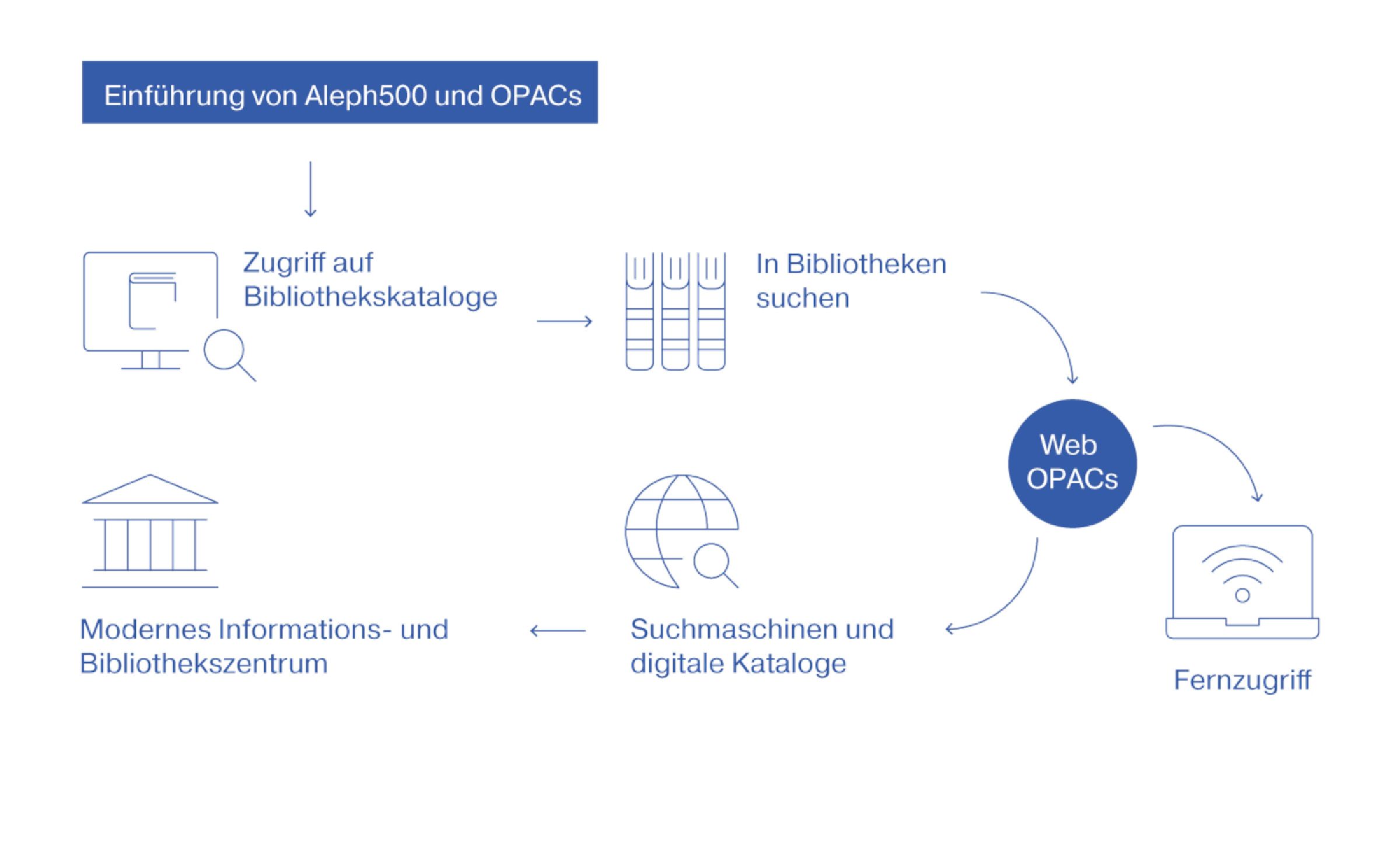
OPACs allowed users to search a library's holdings electronically, significantly streamlining access compared to manual card catalogue searches. This shift laid the foundation for the development of search engines and modern digital catalogues, now accessible across a wide range of devices.