The Austrian Federal Civil Service
Advice
The Austrian Federal Civil Service, previously belonging to the Federal Ministry for Arts, Culture, the Civil Service and Sport, was taken over by the Federal Chancellery on 1 April 2025.
Legal basis for the change of responsibilities is the "Amended Ministerial Law (in German: Bundesministeriengesetz) 1986", amended Act "Bundesministeriengesetz-Novelle 2025, BGBl. I Nummer 10/2025".
Austria’s public service
Public administration in Austria is organized across 3 levels: The federal level, the level of the 9 regions (referred to as Länder), and the local level, which comprises 2,092 municipalities. In a broader sense, the public sector also includes social insurance institutions, statutory representative bodies known as “Chambers” (such as the Chamber of Labour and the Chamber of Commerce), as well as other legal entities established under public law that are responsible for delivering public services.
| Level of government | Staffing levels |
|---|---|
| Federation | 137,687 |
| Regions | 149,269 |
| Local | 87,956 |
| Total | 374,912 |
Employees in the public sector are collectively referred to as the Civil Service. Through their service- and citizen-oriented performance of duties, they play a vital role in generating positive momentum for both society and the economy. While a significant share of civil servants is employed in core areas such as tax and revenue administration, internal and external security, or education, they also perform essential functions across a broad range of other domains. These include the administration of social benefits, the maintenance and development of public infrastructure, food and medicinal product safety, environmental and nature protection, and public health services.
The Federal Civil Service
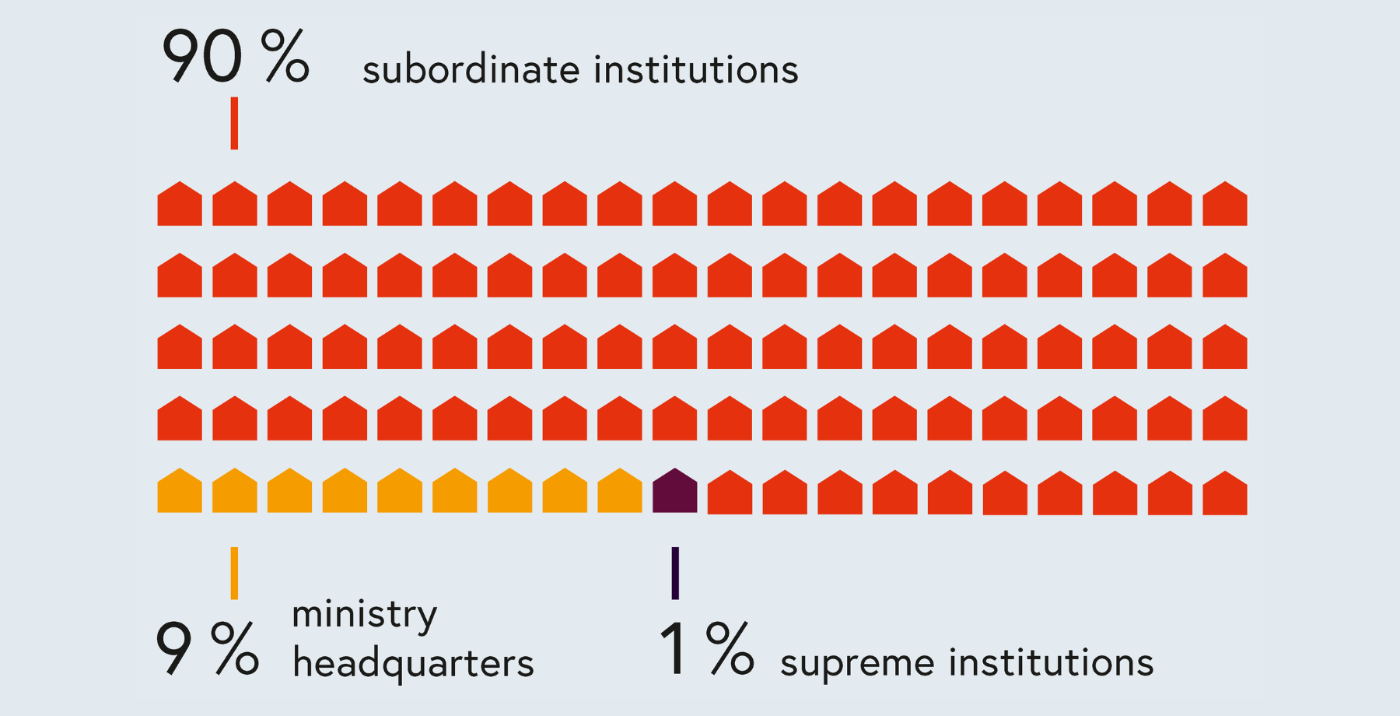
The tasks of the federal government are carried out by the federal ministries and their subordinate institutions. Currently, 9 % of civil service personnel are working in the headquarters of the ministries. The vast majority, 90 %, are assigned to subordinate institutions, including schools, courts, tax offices and police stations. Only 1 % of federal employees are working in supreme institutions, such as the Office of the Federal President, the Parliamentary Administration, the Constitutional Court, the Supreme Administrative Court, the Ombudsman Board and the Court of Audit.
In addition, approximately 2,981 federal civil servants (FTE) are working in agencies established under public or private law that have been entrusted with tasks previously performed by federal civil service institutions. These include Statistics Austria, federal museums, the Public Employment Service, universities, probation services and similar entities. A further 5,329 are employed in the successor companies of the former Post and Telegraph Administration.
Occupational groups in the Federal Civil Service
The Austrian Federal Civil Service consists of eight occupational groups, including administrative staff, schoolteachers, teachers at colleges of education, law enforcement officers, military personnel, judges and prosecutors, nurses, and school supervisory staff. Ministries draw on different groups depending on their mandate. The administrative service is particularly broad, with staff working across nearly all federal bodies. Their tasks include legal, economic, technical, psychological and administrative activities.
Did you know? No single ministry includes all eight occupational groups. The Federal Ministry of Justice comes closest, with five represented.
Retirements in the Federal Civil Service
The average retirement age in the federal civil service was 62.7 years in 2024, remaining virtually unchanged from the previous year. Minor shifts resulted from an increase in early retirements (+ 34) and a decrease in regular retirements (− 56). Notably, the number of new retirements rose in the law enforcement sector, which has the lowest average retirement age, while it declined among teaching staff, who have the highest retirement age. Together, these two occupational groups account for roughly half of all new retirements and therefore significantly influence the overall average. Between 2020 and 2024, the average retirement age remained largely stable. This trend is expected to continue.
Age structure of Federal Civil Service staff
In 2024, the average age of federal staff was 44.3 years. Since 2017, it has shown a slight decline, primarily due to a high number of retirements and increased recruitment, particularly in the law enforcement sector. Despite this short-term decrease, the overall age structure remains imbalanced. A significant share of staff belongs to older age cohorts, while younger age groups are underrepresented. By 2037, approximately 42 % of the current workforce is expected to retire. This development presents major challenges for personnel management, especially with regard to knowledge retention, training, and adapting working conditions to an ageing workforce.
Part-time employment in the Federal Civil Service
In 2024, 18.3 % of civil service staff worked part-time, with higher rates among women than men in both civil servant and private-law employment groups.
Qualification levels of Federal Civil Service staff
The proportion of highly qualified staff has traditionally been high in the Federal Civil Service. The recent process of refocusing on the core tasks of public administration has led to operative units being hived off and turned into separate legal entities such as agencies, as well as certain services being outsourced to private providers. This has caused the percentage of university graduates and those having completed upper secondary education (so-called Matura) to rise even further, to 51.1 %. By comparison, the proportion is only 42.3 % in the private sector.
Internships and apprenticeships
Employment in the Federal Civil Service frequently requires a high level of specialised expertise, depending on the occupational group and the specific position. In order to ensure that new staff are adequately prepared for their responsibilities, all recruits complete a structured initial training programme, which is aligned with their existing qualifications. The Federal Civil Service also offers a range of internship opportunities. These include administrative internships, as well as legal internships (court placements) for law graduates, both of which equip participants with competencies that are also in demand in the private sector. Currently, 1,467 apprentices are receiving training within the Federal Civil Service, making it one of the largest providers of apprenticeship training in Austria. In addition, a further 2,971 7.8 % Men part-time 31.4 % Women part-time apprentices are undergoing training in public entities that have been legally separated from the federal administration. As of 31 December 2024, a total of 854 staff members were enrolled in training for commissioned and non-commissioned officer roles within the Austrian Armed Forces.
Women and men in the Federal Civil Service
Women represent 44.6 % of the workforce in the Federal Civil Service. This share has been rising steadily in recent years, including in occupational areas where women have historically been underrepresented, such as law enforcement and the armed forces. At the national level, women account for 48.0 % of employees in dependent employment, a proportion exceeded in 9 out of 12 federal ministries. By contrast, the share of women in the Federal Ministries of the Interior and Defence remains significantly below the national average. This is primarily due to the high concentration of executive and military roles within these ministries. In the Federal Ministry of Labour and Economy, the difference is comparatively small, with the share of women only around three percentage points below the national figure.
The representation of women in leadership positions is a key indicator of progress towards gender equality. Leadership roles not only entail decision-making authority but are also associated with higher income levels. To track developments over time, the indicator “Women in the highest pay grades” was introduced, covering four levels. The two highest levels refer to positions held by university graduates: Group I includes roles such as Secretaries-General, Directors-General, and Directors; Group II includes Heads of Division, Heads of Unit, and similar functions. Since 2006, the proportion of women in leadership positions has increased across all levels. The rise has been particularly notable in Group I, where the share of women grew by 22.5 percentage points, significantly outpacing the overall increase in the proportion of women in the Federal Civil Service.