From Library Standards to Library Automation
Standardized rules and regulations form a crucial foundation for networking bibliographic data. Yet, library work extends far beyond cataloguing collections. The development of integrated electronic library systems has played a key role in optimizing resource use and streamlining workflows across all areas of library operations.
Cataloguing Rules
The core functions of any library – collecting, cataloguing, and providing access to media – depend on a stable foundation of rules and structures. A shared understanding of how knowledge is organized – established through library guidelines and regulations – is essential.
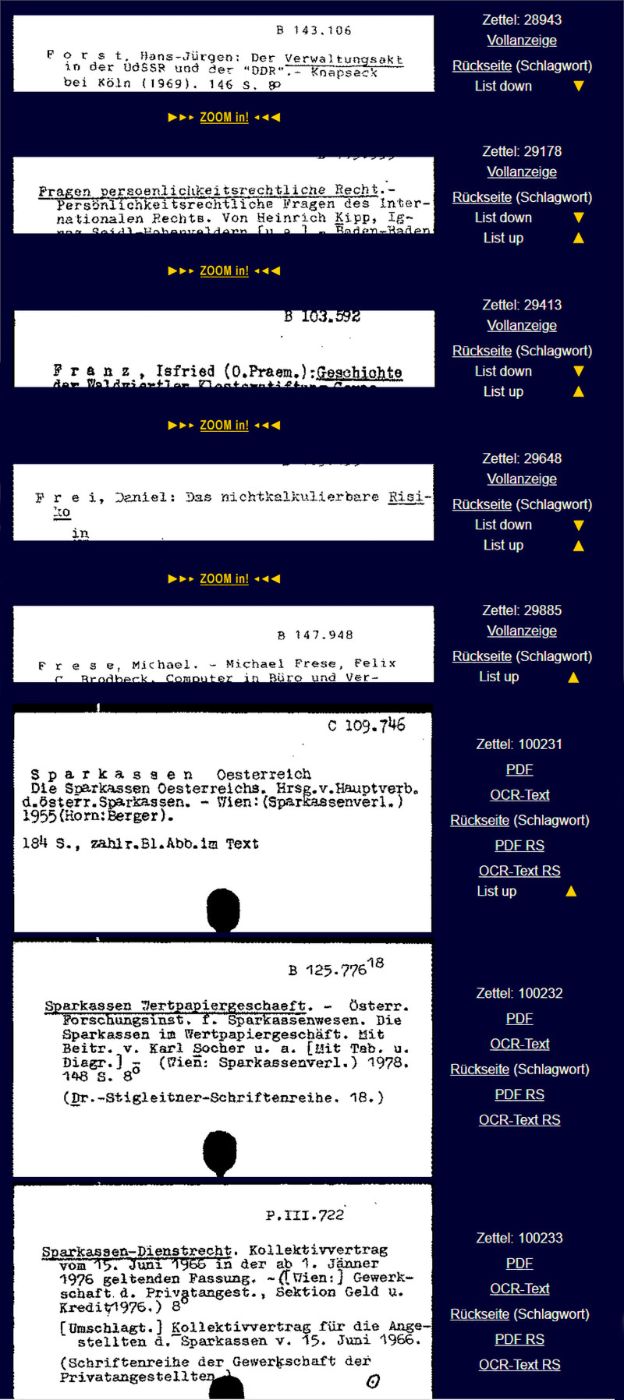
Standards and principles for catalog management are nearly as old as libraries themselves. Written collections were already being organized during the era of cuneiform writing. In the German-speaking world, cataloguing rules were codified as early as 1820 at the Munich Court Library. Around 1900, the "Preußische Instruktionen" developed by the State Library in Berlin became the dominant standard in Germany.
Austria initially followed its own set of cataloguing rules – the "Altösterreichische Beschreibvorschrift" – which remained in place until the 1930s. In the Administrative Library, these standards were replaced by the "Preußische Instruktionen" in 1941. A major step toward standardization occurred in the 1970s and 1980s with the adoption of the Rules for Alphabetical Cataloguing (RAK).
In 2015, RAK were replaced by Resource Description and Access (RDA), a modern, internationally harmonized cataloguing standard. RDA is designed to accommodate both analog and digital content across a wide range of media types.
Paris Principles
The so-called Paris Principles, adopted in 1961 through an initiative of the International Federation of Library Associations and Institutions (IFLA), marked a major milestone in the standardization of cataloguing practices. With delegations from 65 countries participating, a consensus was reached for the first time on the structure and purpose of library catalogs – laying the foundation for internationally coordinated cataloguing standards.
Following this agreement, Germany and Austria began gradually introducing a new standard aligned with these international principles: the Rules for Alphabetical Cataloguing in Academic Libraries (RAK-WB), starting in the early 1970s. Coinciding with the early stages of digitization and the advent of computer use, this development helped set the course for the broader automation of library systems.
Library Automation and the Library of Congress
By the late 1960s, the first libraries began experimenting with automated catalogues. Harvard University in the United States developed the first computer-based catalogue, paving the way for broader adoption. Throughout the 1970s and 1980s, library catalogues were increasingly managed using computers, significantly improving efficiency and accuracy in cataloguing processes.
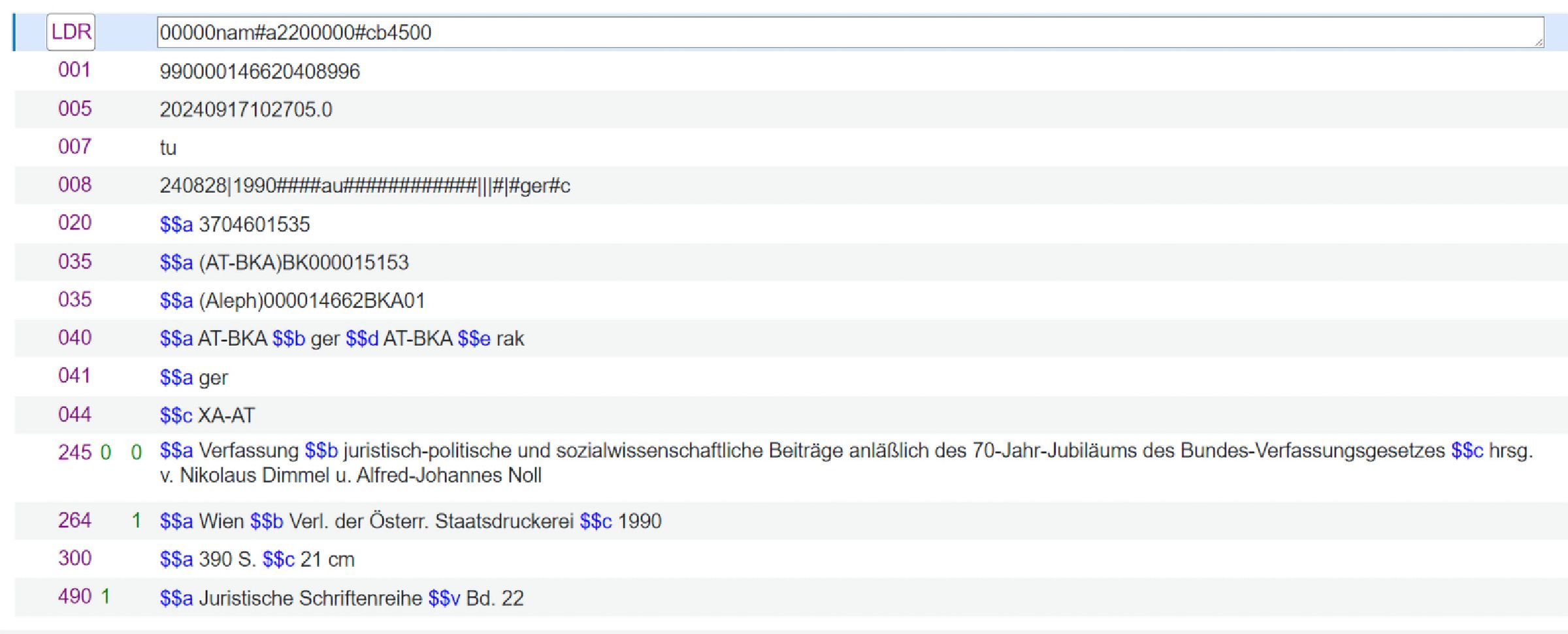
The Library of Congress (LoC) played a pioneering role in many of these technological advancements. As early as the 1950s, it commissioned studies on the automation of library processes, aiming to convert card catalog data into machine-readable formats. In 1965, the LoC was tasked with distributing machine-readable bibliographic data, marking the launch of the MARC I (Machine-Readable Cataloguing) project – a feasibility study investigating whether catalogue data could be generated in a machine-readable form.
At the same time, the British National Bibliography pursued a parallel initiative with its own data. These developments led to the creation of the MARC II format in 1968, establishing a cooperative communication standard used across Anglo-American libraries.
Henriette Avram: The Beginnings of Machine-Readable Data Exchange

Henriette Avram (1919–2006) played a pivotal role in the development of the MARC format. She began her career as a programmer at the National Security Agency (NSA) in the 1950s, where she was among the first to work with the IBM 701. In the 1960s, she transitioned to the private sector, where she was tasked with establishing a computer science library – her first contact with the Library of Congress. In 1965, she joined the Library of Congress as a systems analyst, despite having no formal background in librarianship.
Avram was assigned to the MARC pilot project (1965–1968) to develop an automated cataloging format. Her work went far beyond simply converting catalog cards into digital form. She devised a system of mathematical codes – based on catalog numbers, letters, and symbols – each with specific meanings. This led to the creation of standardized input fields for bibliographic data, which remain essential for the electronic processing, sharing, and reuse of metadata across institutions today.
"MARC is an assemblage of formats, publications, procedures, people, standards, codes, programs, systems, equipment, etc., that has evolved over the years, stimulating the development of library automation and information networks."
Henriette Avram, MARC: Its History and Implications, Library of Congress, 1975