The Administrative Library between 1938 and 1945
March 13, 1938: The Administrative Library is merged with the Library of Parliament
With Austria's annexation ("Anschluss") into the Third Reich and the loss of its sovereignty, the Administrative Library also lost its superior authority. The Federal Chancellery ceased to exist as the highest administrative body and was incorporated into the German Reich as part of the Reich Governor's Office for the Reichsgau Vienna.
The Administrative Library was restructured as the Verwaltungsbibliothek (Administrative Library of the Reich Governor's Office). On April 1, 1941 (retroactively), it was merged with the library of the dissolved Austrian Parliament to form a single institution under Nazi control.
Civil servants and System Change
On June 1, 1938, a decree came into effect reorganizing the Austrian civil service. Under this new regulation, numerous civil servants lost their positions – especially those deemed politically unreliable or targeted under the Nuremberg Laws. Jewish staff and individuals critical of the regime were particularly at risk.
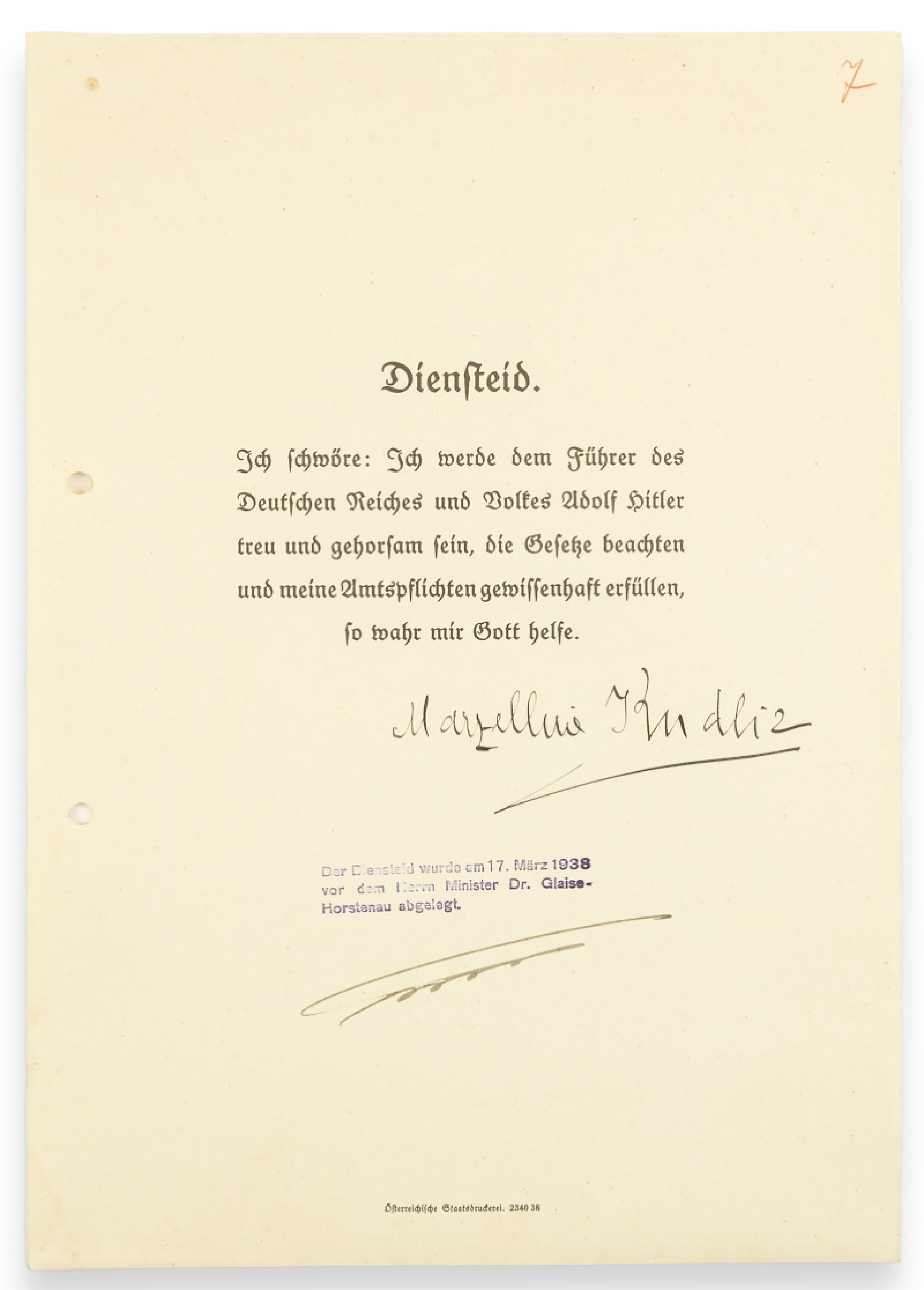
Following the Führer's decree of March 15, 1938, all public officials were required to swear an oath of loyalty – not only to the state but also personally to Adolf Hitler. "Political reliability" and so-called "Aryan descent" were verified through exhaustive inquiries into memberships in various organizations and associations.
Throughout the 20th century, many civil servants in Austria experienced multiple political regime changes: from the monarchy to the First Republic, through the authoritarian Ständestaat, the annexation in 1938, and finally the founding of the Second Republic. Within the span of less than 3 decades, some were compelled to take up to 5 different oaths of allegiance.
Link
Memorial: Severa Wjera Mendrochowicz
Severa Wjera Mendrochowicz was appointed Deputy Head of the Administrative Library in 1925, a position she held until her leave of absence in March 1938. On October 29, 1938, she was forced into retirement under § 3 of the Ordinance on the Reorganization of the Civil Service.
Born on January 4, 1891, in Lviv, Severa was the daughter of an Austrian state railway engineer who passed away in 1898. Her mother later married Julian Romanczuk, a Council Secretary at the Supreme Court in Vienna. The family relocated to Vienna in 1905, settling in Burggasse in the 7th district of Vienna.
Severa Mendrochowicz graduated from high school with distinction on July 5, 1910, and pursued studies in history and geography. She completed her degree with a dissertation entitled "Contributions to the History and Evaluation of the Templar Trial," earning her doctorate with distinction on January 22, 1916.
In March 1916, she began working as an unpaid research assistant at the Administrative Library and was soon assigned to the Lower Austrian Governor's Office. Her ambition and talent led her to apply for admission to the library training program, and she became only the third woman to pass the supplementary examination at the Institute for Austrian Historical Research.

On November 23, 1918, Mendrochowicz entered the Austrian civil service as a library trainee. Just seven months later, in June 1919, she was promoted to State Library Assistant II. In December 1920, she became a State Librarian of the First Class, and in 1923 she was awarded the title of State Librarian. In 1925, she reached the pinnacle of her career with her appointment as Deputy Head of the Administrative Library.

Her promising professional trajectory came to an abrupt end following the Nazi seizure of power in March 1938. Due to her Jewish heritage, she was forced to resign from public service.
After her dismissal, nearly all traces of her disappear. The last official document on record is dated August 15, 1940, in which she notifies the Chief Finance President that, in future, all payments must be made into a blocked account at the Länderbank.


A handwritten note from her stepfather, Julian Romanczuk, dated late April 1942, states that Severa Mendrochowicz had been missing since September 18, 1941. 10 months later, in July 1942, she was found dead near Pressbaum.
Severa Mendrochowicz's name does not appear on any official list of Austrian victims of the Nazi regime, as such lists are limited to those who perished in the Holocaust.
The staff of the Administrative Library
Guido Mayr-Werchota, Head of the Administrative Library since 1925, was forced into retirement in 1938 under § 6 of the Professional Civil Servants Ordinance.
(§ 6: "To simplify administration or in the interest of the service, civil servants may be retired (...) even if they are not yet unfit for duty.")
He was replaced by Hermann Oberhummer, previously a librarian at the Vienna Federal Police Directorate – a clear promotion for a committed supporter of the authoritarian corporative state.
The library's former Deputy Director, Severa Mendrochowicz, was forced into retirement on October 31, 1938, under § 3 of the same ordinance, due to her Jewish heritage.


Ludwig Bäuerle was likewise retired on December 12, 1938, under § 3. Emma Ackermann was forcibly retired under § 6.
Following the end of the war, Guido Mayr-Werchota, Ludwig Bäuerle, and Emma Ackermann were able to resume their professional duties. Mayr-Werchota was reinstated as Head of the Administrative Library.
Hermann Oberhummer, a former member of the NSDAP, was suspended from service in 1945. Before disciplinary proceedings could be initiated, he submitted a pension application, which was granted in 1947 after he was classified as less incriminated ("minderbelastet") under the 1947 Prohibition Act.


Everyday Library Life at Herrengasse 23
The impact of the war is clearly reflected in the Administrative Library's operational records. Heating the library rooms became increasingly difficult due to coal shortages, and the building's air-raid shelter had to be regularly adapted to meet changing safety requirements. To protect the collection from damage during air raids, large portions of the holdings were relocated. Approximately 30,000 volumes were transferred for safekeeping to the Church of St. Josef ob der Laimgrube in Vienna's 6th district.
Amid growing shortages, the campaign for "metal mobilization in public administration" also reached the library. The Administrative Library reported approximately 150 brass door handles at Herrengasse 23 that could be surrendered for the war effort.
Book Acquisitions During the Nazi Era
In accordance with the Administrative Library's collection focus, acquisitions during the Nazi era included legal texts, administrative journals, and official gazettes. Additionally, works concerning the institutions of the Greater German Reich were procured. The collection also expanded to include publications issued by the High Command of the Wehrmacht, as well as increasingly antisemitic and German nationalist literature.
One striking aspect is the comparatively large number of guidebooks acquired during this period. These were intended to enhance knowledge about the territories conquered by the German Wehrmacht and reflect the ideological goals of the regime.
Following the defeat of the German Wehrmacht at Stalingrad in February 1943, the library's acquisition records show a marked decline in new purchases, mirroring the worsening course of the war. This downward trend continued until the end of the war in 1945.
The end of the war and the political turning point are also reflected in the inventory records. A handwritten entry dated June 11, 1945, appears in new script:
"Die österreichischen Wiedergutmachungs-Gesetze. Erläuterungen hierzu von Dr. Ludwig Haydn" (The Austrian Reparation Laws. Explanations by Dr. Ludwig Haydn).


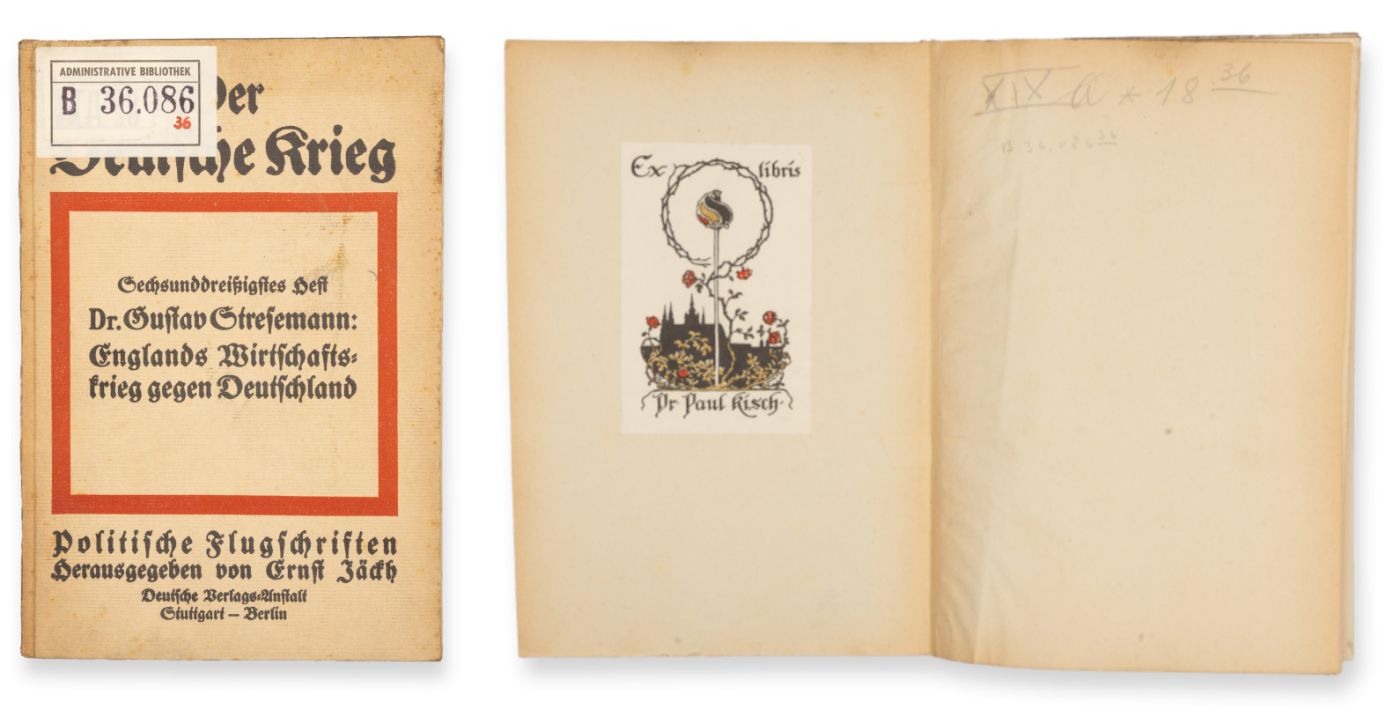
Provenance Research at the Administrative Library
Since 2023, 2 research projects have been dedicated to examining the Administrative Library's history during the Nazi period. The Commission for Provenance Research is preparing dossiers on individuals whose books remain in the library's collection and whose acquisition histories raise questions under the Art Restitution Act (Federal Law Gazette I No. 181/1998). These individuals include lawyers, journalists, and senior civil servants such as Leo Gross, Arthur Ballin, Hans Pernter, Rudolf Schalek, Raoul Allgayer, and Paul Kisch.
A second project focuses on reconstructing the institutional history of the Administrative Library under National Socialism, offering deeper insight into its role and development during this period.